Read on to Understand Fact Versus Fiction Regarding This and Other Pa Myths.

DISTINGUISHING Between FACT AND OPINION
For higher-level reading comprehension, it is essential that students are able to accurately distinguish between fact and opinion. To exercise this successfully students must begin with solid definitions of the two concepts. Once this has been achieved, students must gain practice applying these definitions through activities that engage with a broad range of reading material.
Let's take a wait at defining these ii all-important concepts:
WHAT IS A FACT?
A fact generally refers to something that is true and can exist verified as such. That is, a fact is something that can be proven to be true.
A COMPLETE UNIT ON FACT AND Stance

Digital and social media has completely redefined the media landscape making it really hard for students to identify FACTS AND OPINIONS.
Teach them to FIGHT Imitation NEWS with this Complete 42 PAGE Unit of measurement. No preparation is required.
WHAT IS AN OPINION?
An opinion refers to a personal belief. It relates to how someone feels near something. Others may concord or disagree with an stance, but they cannot prove or disprove it. This is what defines information technology as stance.
Why Are Fact and Opinion And so Important?
The power to distinguish between fact and opinion helps students develop their critical and belittling skills in both their reading and their listening. Fact and stance are often woven together in texts and speeches. It is therefore imperative that students are able to unravel the threads of what is true from what is mere belief if they are to successfully navigate the deluge of media they will encounter in their lifetimes.
Whether on the news, in advertizement, or in a history book, distinguishing between what is fact and what is opinion is crucial to becoming an democratic person with the critical abilities necessary to avoid existence manipulated easily.
The Linguistic communication of Fact and Opinion: Signal Words and Phrases
Equally we mentioned above, frequently writers volition liven up their facts with a sprinkling of opinion. Unfortunately, information technology can at times be difficult to extract the verifiable truths from the author's preferences and biases. Luckily the language used itself often throws up helpful clues in the forms of words and phrases that assist u.s. in identifying statements equally fact-based or opinion-based.
Let's at present take a await at some examples of those bespeak words and phrases being used in the sentence fragments that frequently precede a statement of fact or opinion:
FACT
● The annual report confirms …
● Scientists have recently discovered …
● According to the results of the tests…
● The investigation demonstrated …
Stance
● He claimed that…
● It is the officeholder'due south view that…
● The written report argues that…
● Many scientists suspect that…
As we can see from the above examples, the language used to introduce a argument can be helpful in indicating whether it is being framed equally a fact or an opinion.
It is important for students to understand too that things are not always as they appear to be. At times, writers, whether consciously or not, will frame stance as fact and vice versa. This is why it is important that students develop a clear understanding of what constitutes fact and opinion and are afforded ample opportunities to practice distinguishing between the two.
WHAT IS CONTEXT?
Context is the circumstances surrounding an event, statement, or idea, and in terms of which it tin can be fully understood. Facts and opinions must exist placed in context to draw conclusions from.
For instance, a young male child who tells his female parent "I ate a truckload of sweets at the political party last nighttime" needs to be placed in the context of his historic period, and audience.
Nosotros can confidently infer he never actually ate a real truckload of sweets, but nosotros tin reasonably appreciate he ate a lot of them and wanted to emphasise that point.
His female parent might inquire a clarifying question to turn that stance into a difficult fact.
USING GRAPHIC ORGANIZERS
Graphic organizers are a great tool to assistance students sort the facts and opinions in a text. Offering, as they do, a very visual ways of organizing information, graphic organizers aid students drill their power to distinguish between the two types of statements until they become automatic.
Let's take a look at 1 particularly useful format for developing this skill:
The Fact and Opinion Chart
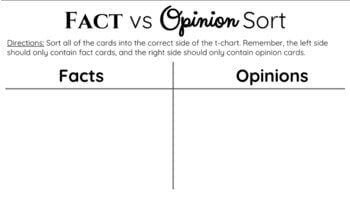
This simple chart consists of two columns helpfully labelled fact and opinion below a topic heading. Students work their style through a piece of text, sorting statements as they come across them into the advisable column on the graphic organizer. At the end of this task, they will be left with a articulate segregation of the statements of the text according to whether they are objective facts or subjective opinions.
Fact and Opinion Activities: Honing the Skills
To become a skilled, critical reader a student must develop the ability to chop-chop evaluate a text for fact and stance. To achieve this, they must practice distinguishing between fact and opinion to a point where it becomes a hidden mechanism. The activities beneath will afford your students these necessary opportunities. They tin also easily be adapted to a range of ages and abilities through careful selection of the reading material. READ OUR Bang-up ARTICLE ON LITERACY GRAPHIC ORGANIZERS Here
Fact and opinion activities for students
Student Action ane. Top 10 Facts and Opinions
Not but does this simple action aid students hone their fact and opinion detecting abilities, it besides serves equally a bully warm-up enquiry action when beginning a new topic in form.
When starting a new topic, whether on a historical flow, a literary effigy, or a species of animal, ready students the task of list ten facts and opinions from their background reading and research on their new topic. Students must then class and listing ten opinions on the topic based on reflection on this initial reading and research.
It may too be a useful do for students to look dorsum over their opinions at the end of the topic. Have they changed their opinion in any areas of the topic? Why did they alter, or maintain, their stance? This can work every bit a great review activity to wrap things upward.
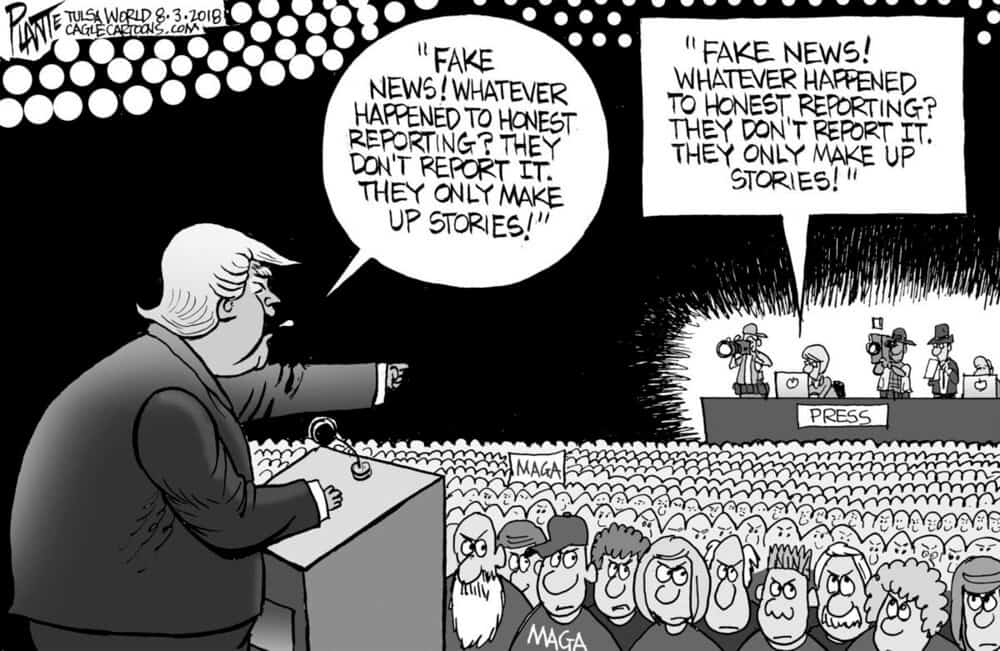
Student Action 2. Evaluate an Editorial
Newspaper editorials can be a superb resource for students to do recognizing facts and opinions. They are filled with the editor'south opinions on the issues of the day, intermingled with facts that are selected to support that opinion.
First, give students copies of a newspaper editorial. Then, working in pairs, have students go through the editorial identifying the facts by underlining them and the opinions by highlighting. Remind them to look for the point words we covered earlier to help identify facts and opinions.
When they accept finished, students tin can then compare their answers and hash out the reasons for the decisions they fabricated. This will help to place any areas of confusion inside the course; providing yous with useful data to inform your future planning on this topic.
FACT AND Stance ACTIVITIES FOR STUDENTS
If y'all are looking for a broad range of engaging tasks to teach students about fact and opinion, you lot have establish it.
ThisHUGE 120 PAGE resource combines four distinct fact and opinion activities you can undertake as aWHOLE Group or asIndependent READING Grouping TASKS in eitherDIGITAL orPRINTABLE TASKS.
Student Activeness 3. Fact vs Opinion Survey
This activeness can initially exist undertaken using statements compiled on a worksheet. Later, students can piece of work through passages of text, or even through the textbook itself direct. Students simply work through a serial of statements marker either F or O beside each to place that statement every bit a Fhuman activity or an Opinion.
This activity is an effective study preparation practice as it helps students to filter factual content from opinion. It besides makes it easier for students to work out the underlying purpose of a text, whether it is designed to inform, persuade, or entertain. Students will before long brainstorm to recognize that passages of text that comprise more facts than opinions are about probable intended to inform, while a text that is more stance-based will near likely be intended to persuade or entertain.
Pupil Activity 4. The Great Fact or Opinion Sort
Organize students into reasonable-sized groups of iv or five students. Provide each group with a jar containing a set of cards, each with a fact-based or an opinion-based statement printed on it. Students take turns picking a card from the jar and reading it to the group. The group discusses each statement before deciding if it a fact or an stance.
Students can then record the statements appropriately on the Fact and Stance Chart described above or simply sort them into 2 piles.
This activity serves as an effective method to support struggling students as they get to learn from those students who accept already developed a firmer grasp of the two concepts.
Extension Practise: Identifying Bias
One reason information technology is so important for our students to learn to differentiate between fact and opinion is that this ability is a stepping stone to detecting bias in a text. Students begin to evaluate a text for bias by first identifying how much of the text is fact-based and how much is based on opinion.
Once this is done, students must then analyse whether the opinions expressed in the text are biased past considering whether the writer has:
● Provided incomplete information
● Intentionally ignored or left out data to persuade the reader
● Allowed their ain personal experiences to cloud whatsoever sense of objectivity.
In Conclusion
Non only is the ability to identify bias in the writing of others essential, but this knowledge will also be of swell benefit to students when it comes to forming and expressing their ain opinions.
Taking the time to set up and deliver detached lessons on how to recognize fact and opinion in reading is essential. No thing how confident students are in distinguishing betwixt the two, they are still likely to benefit from further practice. Even the most reflective of us can remain ignorant of our own biases at times!
To get the critical readers that our students aspire to go begins with the germination of articulate definitions of the terms in the students' minds. These definitions must exist supported by examples and illustrations to achieve this. Student agreement must be further underpinned by practice in the classroom and at home. The activities to a higher place serve as a good starting indicate, merely they are non sufficient on their ain.
It volition be necessary to farther support students to gain a deeper agreement of fact and opinion (and related concepts such equally bias) past making regular reference to these concepts when engaged with students in lessons with other explicit objectives that are seemingly unrelated to fact and opinion. Reinforcement should be persistent to ensure students develop business firm skills in this area.
With ongoing advances in technology, assessing the reliability and truthfulness of the media we consume on a daily basis has never been more challenging – or important.
OTHER GREAT ARTICLES RELATED TO FACT AND OPINION

How to Spot Fake News: Lessons and Activities for Students
FAKE NEWS: A DEFINITION "False or misleading content presented as news and communicated in formats spanning spoken, written, printed, electronic, and digital communication." Nolan Higdon, Media Scholar Despite popular opinion, the term Fake News has been effectually for quite a while. Though it certainly has get something of a buzzword in contempo years. Gone are…

How to write a Descriptive Text
WHAT IS A DESCRIPTIVE TEXT? A descriptive text usually focuses on describing a single location, object, result, person, or identify. It endeavors to engage all five of the reader's senses to evoke the sights, sounds, smells, tastes, and experience of the text's subject. Equally with all genres of writing, we tin guide our students on…
Teaching Proofreading and Editing Skills
Teaching Students Proofreading and Editing Skills Skilful writing is as much well-nigh what is taken out of a text as it is nearly what goes into information technology. For our students to get confident and proficient writers, they must develop their proofreading and editing skills. Learning the various aspects of proofreading and editing takes fourth dimension and…

Data Literacy and Media Literacy for Students and Teachers
A Instructor's Guide to Media and Information Literacy What is Literacy? Up until adequately recently, when we used the term 'literacy' in a word it would about probable be in reference to the reading and writing of texts. These days, withal, the definition of literacy extends well across its once conventional apply in reference…

Teaching Compare and Contrast
Comparative Thinking Skills: Educational activity Students to Compare and Contrast The ability to compare and contrast is 1 of the first college-order reading comprehension skills students are introduced to. And it is no wonder, as the ability to categorise and compare things in terms of their differences and similarities corresponds to some of the earliest stages…
What is an inference? And how to teach it.
WHAT IS AN INFERENCE? We've all been there at some point, a blank-faced educatee stares back at usa in response to our question and states "I don't know, teacher. It doesn't tell us in the story." Unremarkably, this response has been incited past an inferential question, but what exactly is inference? Inference can be divers…

Content for this page has been written by Shane Mac Donnchaidh. A former master of an international school and academy English lecturer with 15 years of teaching and administration experience. Shane'due south latest Book the Complete Guide to Nonfiction Writing can be found hither. Editing and back up for this article have been provided by the literacyideas team.
barnestherstrewher.blogspot.com
Source: https://literacyideas.com/teaching-fact-and-opinion/
0 Response to "Read on to Understand Fact Versus Fiction Regarding This and Other Pa Myths."
Postar um comentário