what percentage of an uber fare goes to the driver
About Uber and Lyft passengers have no idea how much of their fare goes to their drivers, merely after a ride is finished, their drivers tin meet exactly how much — or petty — of the fare they keep. That helps explicate why Uber drivers took to the street this week in advance of Uber'southward blockbuster public offering Fri.
The companies' accept is not a fixed percentage of the fare. They charge passengers an upwardly-front fare based on the trip'south estimated length and duration, plus whatsoever surge pricing that may exist in event, minus whatever promotional discounts. Unlike taxi fares, which are regulated and pretty transparent, Uber and Lyft can charge riders any they recall the market will bear at any place and moment in time.
They pay drivers based on actual time and altitude, plus a cutting of any surge pricing and incentives that might be in event. Drivers get 100% of tips passengers may pass along.
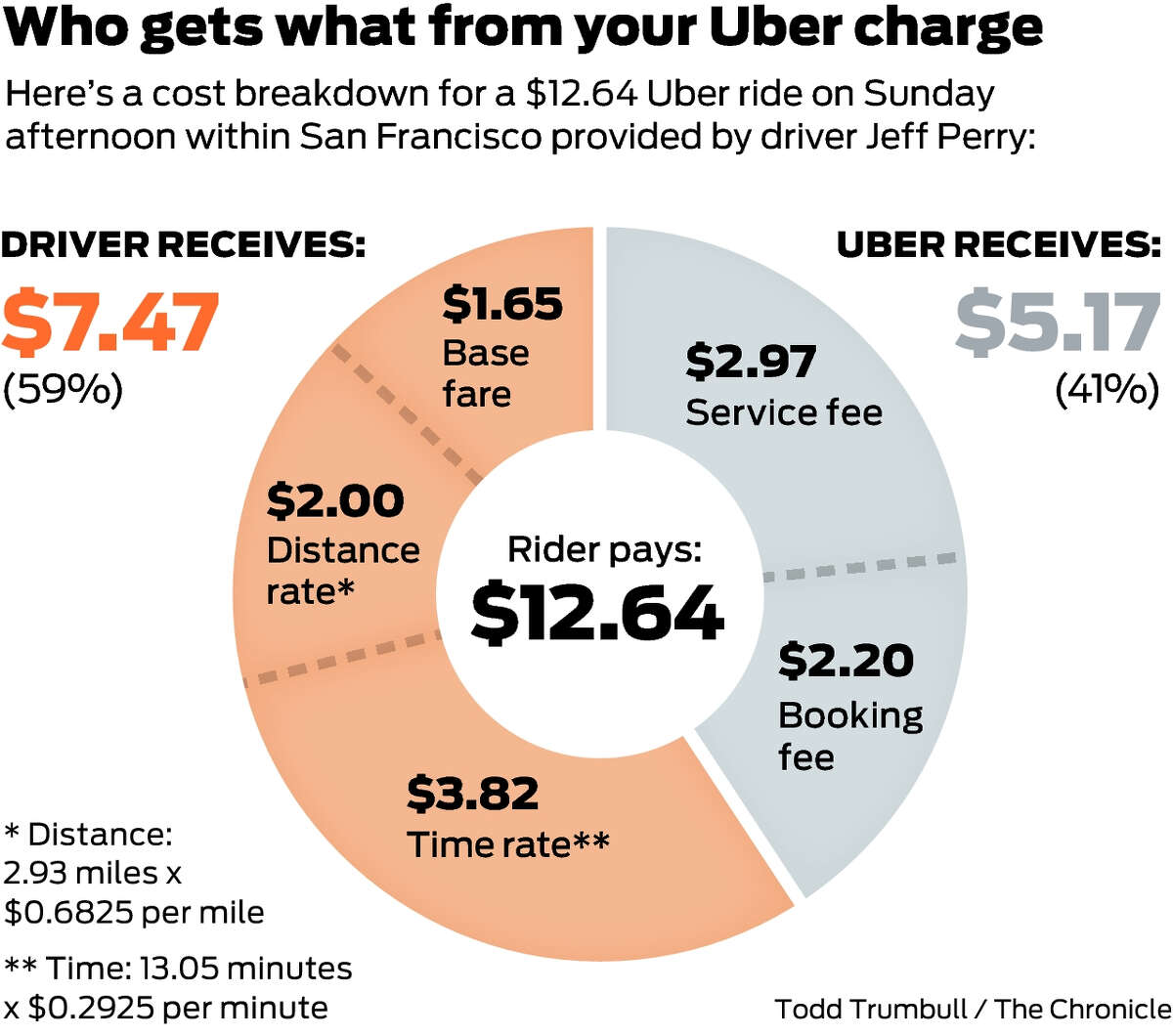
The difference between the passenger fare and the driver fare is the visitor's take, and it'southward made up of two parts: a flat fee that varies by market (it's typically $ii.20 per ride in the Bay Area) and a variable fee that is all over the map.
If you include both fees, Uber's share of the fare averaged almost xxx%, co-ordinate to an unscientific sample of ii dozen trip breakdowns I got from five Bay Surface area Uber drivers this week. (I excluded tolls, aerodrome fees and tips from the calculation.) 1 was negative, which ways Uber lost coin on the ride. The residue ranged from 19% to 45%. Commuter Jin Lan said he'south seen Uber or Lyft take equally much equally 60% of the fare.
That'due south higher than what the two firms reported in their prospectuses. Uber said its ride-hailing "have rate," a complicated formula that essentially reflects its share of rider fares, was 21% last year, "varying from 12% to 24% by region." Lyft said its take rate, which it calls "revenue equally a percentage of bookings," was 26.viii% final year, just that included revenues from things like electrical scooters and wheel rentals, in addition to car trips.
Lyft said in its earnings call Tuesday that it would no longer report gross bookings or take rates, which contributed to a near 11% drib in its stock toll Wednesday, said Dan Ives, an analyst with Wedbush Securities. Lyft shares recovered somewhat Th, rising iv.3%.
Every bit independent contractors, drivers must pay from their cut of the fare all expenses including gasoline, maintenance, depreciation on their cars and self-employment revenue enhancement.
Neither Uber nor Lyft would comment for this story, but on its website, Uber illustrates how information technology sets rider fares and driver pay.
"Uber'due south service fee is the departure betwixt what the passenger pays and what the driver earns. It tin can vary from trip to trip, and it helps fund our platform'due south operations, driver promotions and supports innovation that enables united states of america to serve more than riders and drivers," it says.
Information technology'southward that variability, and unpredictability, that perplexes some drivers.
On a Facebook page for Bay Area Uber and Lyft drivers, a driver named Mikhail posted a screenshot of a trip this month that started during the morning rush hour in San Francisco and ended in Palo Alto. The rider paid $109.21, the commuter got $68.45 and Uber got $40.76, or 37% of the fare, said Mikhail, who did not want his concluding name used out of fearfulness of reprisal from Uber.
On the same trip, with the same rider, a couple of months earlier, he made nigh $15 more, but couldn't observe out why, even after visiting an Uber service center in San Francisco. "They did not understand why, either," he said.
Harry Campbell, founder of the Rideshare Guy web log for drivers, said many are reluctant to be identified for fear of being deactivated, or kicked off the app.
"Uber's deactivation process is very opaque. I don't call up they'd ever fire a driver over something they read. Simply a driver tin be deactivated for anything; in that location is no formal entreatment process," he said.
Campbell solicits trip details from readers and said the most he's ever seen Uber or Lyft have from a passenger fare is seventy%, which is unusual. The companies' take can vary widely, he said, because the fare passengers pay is based on the company'due south gauge of the trip. Driver pay is based on bodily time and distance. If the company'south algorithm miscalculates the trip, its cut could be more or less than intended. But, he said, "I've never understood how information technology could be off (by 70%) and why Uber and Lyft don't cap their commissions."
On the flip side, the companies tin sometimes lose money on a ride. Drivers say this is most mutual on shared rides, where the driver picks up unrelated passengers at multiple locations.
"If they think it's a $10 ride and there is a 50% chance" of matching the rider with another passenger, "they may charge (the offset passenger) $5," Campbell said. If the second passenger doesn't materialize, the visitor's variable fee could exist negative after paying the driver a minimum guaranteed rate.
On a contempo UberPool trip, commuter Annette Rivero picked up ii separate riders in the South Bay who paid a total of $xiv.35, including a 50 cent tip. Uber charged a $ii.20 apartment fee for each passenger, but its variable "service" fee was negative $ix.12. Rivero said the ride probably took longer than Uber expected because she had to use city streets rather than the state highway to pick upwardly the 2nd rider.
Uber says information technology loses money on some rides on purpose. Hither's a passage from its prospectus: "In certain markets, other operators may use incentives to endeavour to mitigate the advantages of our more liquid network, and we will generally cull to match these incentives, even if it results in a negative margin, to compete effectively and grow our business."
Kathleen Pender is a San Francisco Relate columnist. E-mail: kpender@sfchronicle.com Twitter: @kathpender
barnestherstrewher.blogspot.com
Source: https://www.sfchronicle.com/business/networth/article/For-a-driver-s-pay-what-s-fair-in-an-Uber-13830931.php
0 Response to "what percentage of an uber fare goes to the driver"
Postar um comentário